
Researchers from STOP-MATING partner institutions visit us
Researchers from Institut Pasteur de Bangui and Institut Pasteur de Madagascar join our lab for a period of knowledge exchange, hands-on research and scientific collaboration within the STOP-MATING project.



We have recently welcomed three researchers from STOP-MATING partner institutions to the Animal Health Research Centre (CISA-INIA-CSIC) in Alcalá de Henares: Claire and Yvon, from the Institut Pasteur de Bangui (Central African Republic), and Menja, from the Institut Pasteur de Madagascar. Their visit is part of the secondment programme of STOP-MATING, which exchanges researchers between European and African partners under the MSCA Staff Exchange scheme. The aim is to promote knowledge sharing, hands-on training and close cooperation between scientific and technical teams.
Claire is Deputy Head of the Medical Entomology Laboratory in Bangui. Her work focuses on the ecology, behaviour and control of malaria and arbovirus vectors. Yvon is a biochemist and laboratory technician in the same unit, with extensive experience in the field sampling, identification and molecular characterisation of mosquito vectors. Menja is a researcher in the medical entomology unit in Madagascar, where she studies mosquito-host interactions and arbovirus surveillance.
During their stay, Claire and Yvon are working in Marta Andres' laboratory on the development of mating disruptors, a strategy that aims to control disease-transmitting mosquitoes by interfering with their reproductive behaviour. Menja is studying mosquito mating behaviour and acoustic communication, including swarming and wing-beat frequency.
It is a pleasure to share the lab, the techniques and the discussions with them. We thank them for their time and their contribution, and we look forward to continuing the collaboration within STOP-MATING.
Our Research on Mosquito Mating and Vector Control
Our latest study has been featured in a Science news article. Read how our findings contribute to the understanding of mosquito mating and vector control.
04th August, 2026
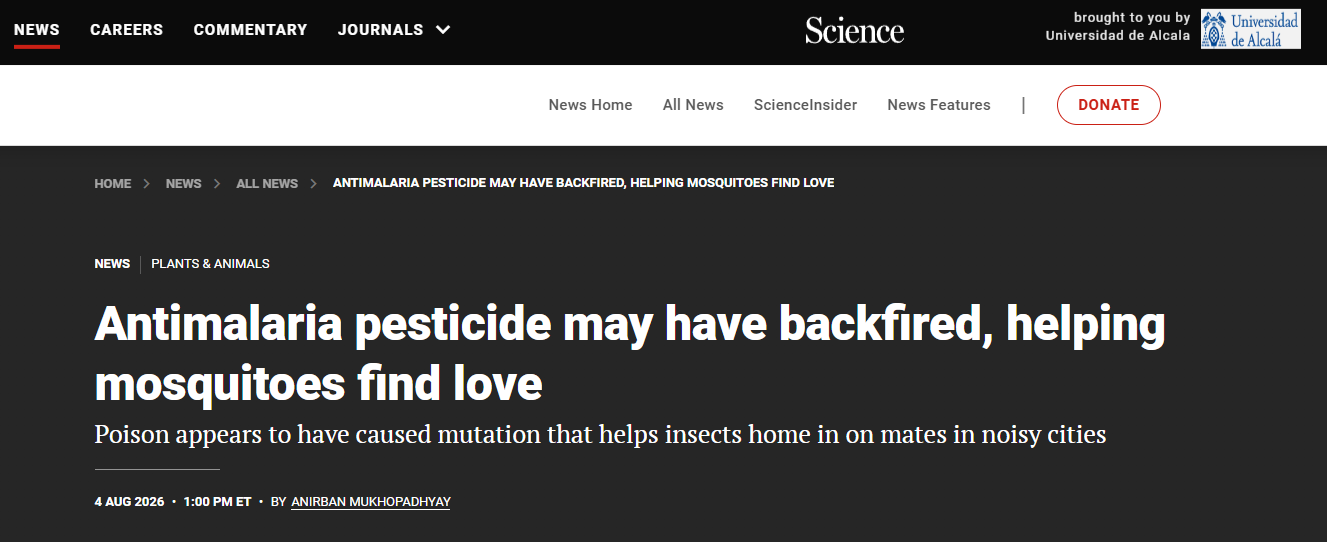
We are delighted that our recent study has been featured in Science in a news article highlighting the potential implications of our findings for mosquito behaviour and vector control. The article, written by Anirban Mukhopadhyay, explores the broader significance of our work and places it in the context of current efforts to develop innovative strategies against mosquito-borne diseases.
We invite you to read the full article:
"Antimalaria pesticide may have backfired by helping mosquitoes find love" — Science.
[Read the full post] and our pusblished article https://doi.org/10.64898/2026.05.20.726456
The Mosquito Molecular Neuroscience lab co-organized de Mosquito neuroethology and neuroecology symposium at the International Congress of Neuroethology 2026 in Vancouver
30th July, 2026
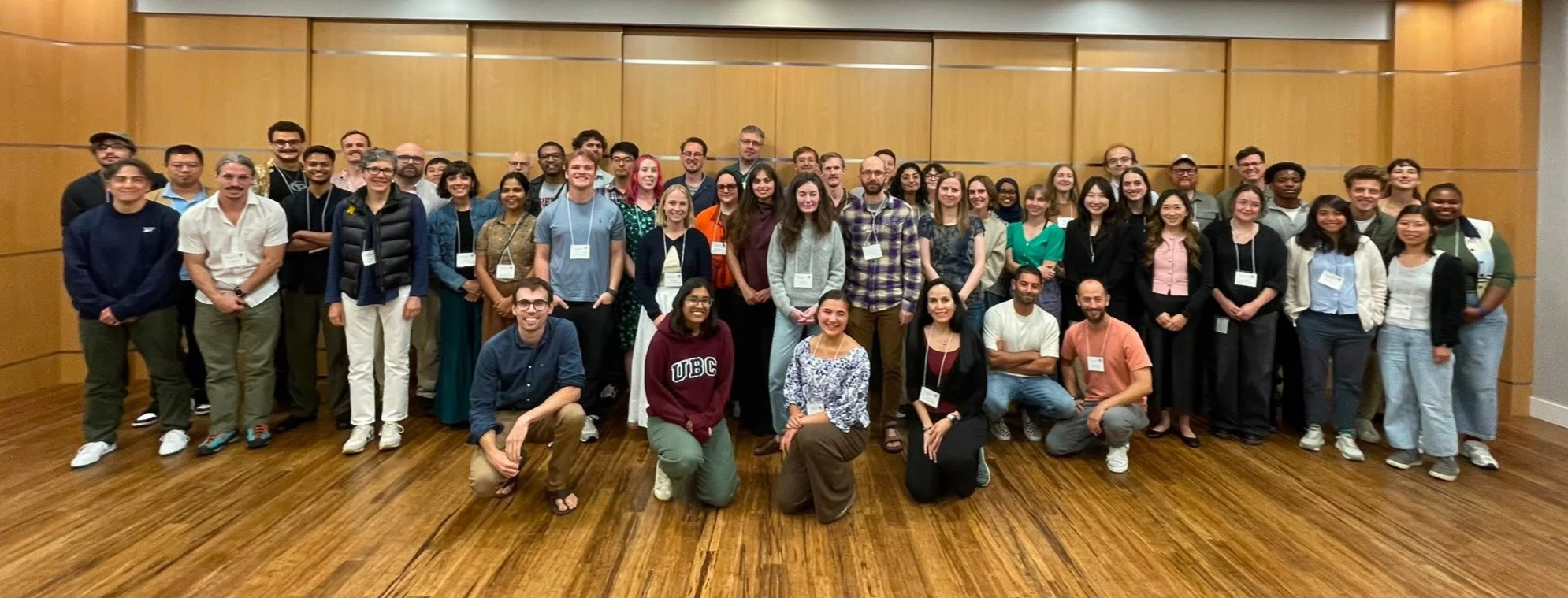
The Mosquito Molecular Neuroscience Lab participated in the organization of the Mosquito Neuroethology and Neuroecology symposium, held within the framework of the International Congress of Neuroethology (ICN 2026), which took place from July 26–31, 2026, at the University of British Columbia in Vancouver, Canada.
The International Congress of Neuroethology is one of the leading global meetings in the field, bringing together researchers studying how nervous systems generate and control natural behaviours across diverse animal species. Organized by the International Society for Neuroethology (ISN), the congress provides a platform for scientific exchange, collaboration, and discussion of the latest advances in neural mechanisms underlying animal behaviour.
The Mosquito Neuroethology and Neuroecology symposium brought together scientists working on mosquito sensory systems, neural circuits, behaviour, and ecological interactions. The session highlighted recent discoveries on how mosquitoes perceive and process environmental cues, communicate, reproduce, and adapt their behaviour, providing new insights into the complex relationship between mosquito neurobiology and ecology.
Through its involvement in the co-organization of this symposium, the Mosquito Molecular Neuroscience Lab contributed to strengthening international collaborations and promoting the study of mosquito neuroscience within the broader neuroethology community. This participation reflects the laboratory’s commitment to advancing knowledge of the molecular and neural mechanisms that shape mosquito behaviour, with important implications for understanding disease-vector biology.
The CISA-INIA-CSIC institution (Madrid) welcomes the STOP-MATING Consortium for an International Workshop on Mosquito Mating Disruption
April, 2026
The Mosquito Molecular Neuroscience Lab successfully organized the STOP-MATING Project Workshop: Novel Strategies to Disrupt Mosquito Mating for Vector Control, bringing together researchers from different disciplines to discuss innovative approaches for understanding and disrupting mosquito reproduction as a strategy to combat mosquito-borne diseases.
The workshop, held at CI2A-CSIC in a hybrid format, introduced the goals and scientific vision of the STOP-MATING project, a European initiative funded through the Marie Skłodowska-Curie Actions (MSCA) Staff Exchanges programme. The project brings together partners from Europe and Africa to investigate the molecular, neurobiological, ecological, and behavioural mechanisms underlying mosquito mating, with the long-term goal of developing novel and sustainable vector control tools.
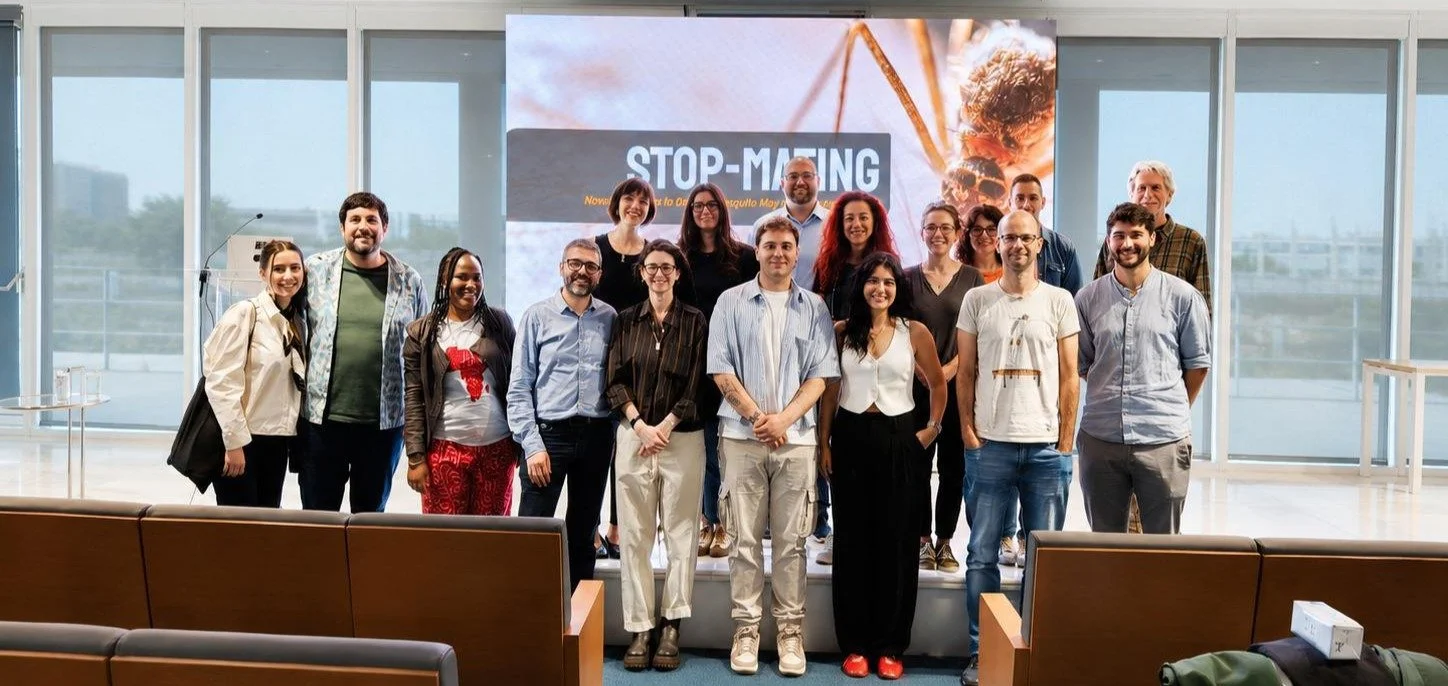
The event featured project presentations by consortium members, including Marta Andrés (INIA-CSIC) and Federica Bernardini (Imperial College London), together with invited talks from leading researchers working in vector ecology, tropical medicine, neuroscience, and insect behaviour. The programme fostered lively discussions on recent advances in mosquito biology, auditory communication, field ecology, functional genomics, and emerging technologies aimed at disrupting mosquito mating.
Beyond showcasing the scientific objectives of STOP-MATING, the workshop provided an excellent opportunity to strengthen collaborations, exchange expertise across disciplines, and promote knowledge transfer among researchers. These interactions are essential for accelerating the development of innovative, environmentally responsible strategies to reduce mosquito populations and ultimately contribute to the control of mosquito-borne diseases worldwide.
March, 2026
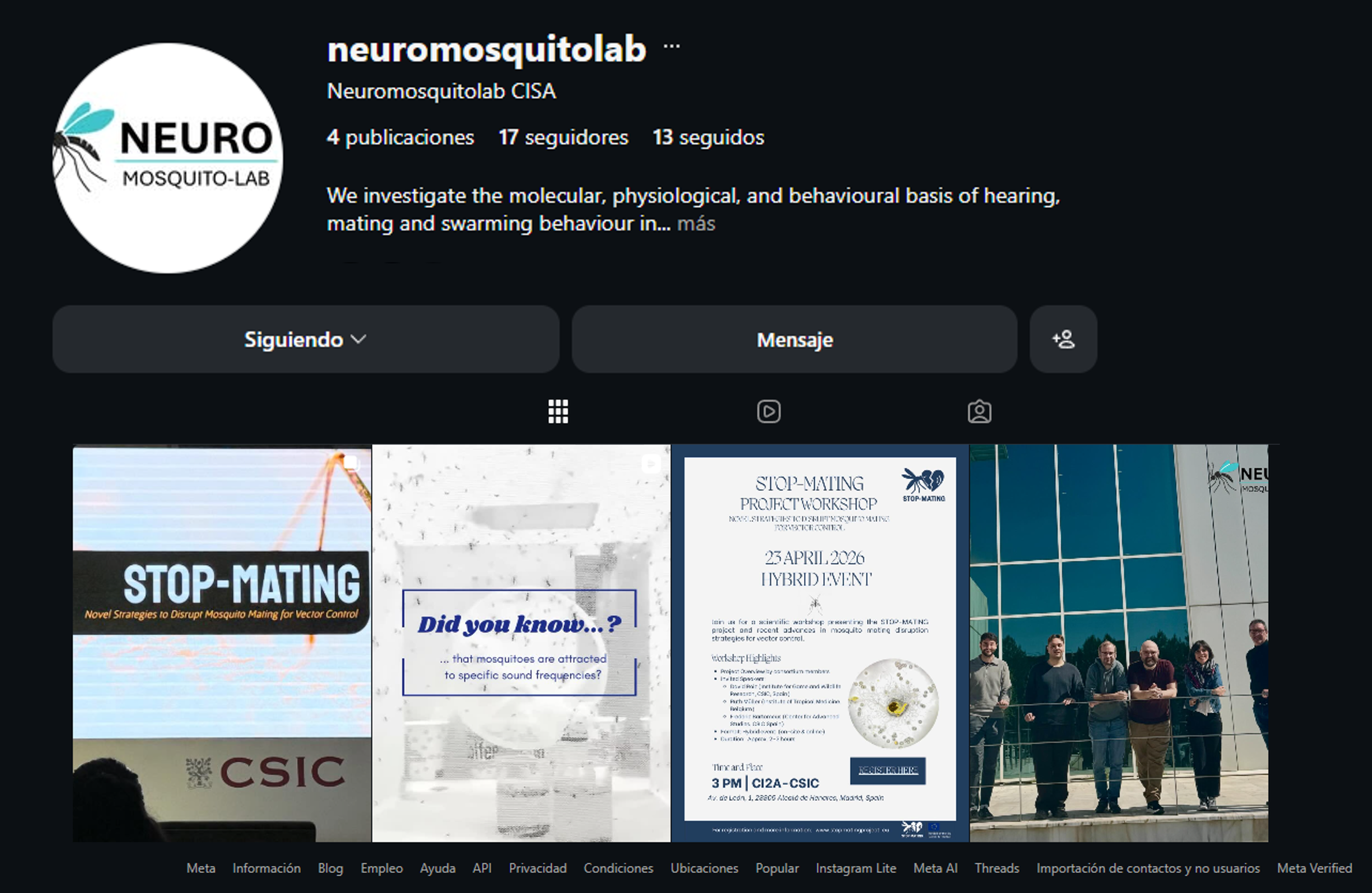
The Mosquito Molecular Neuroscience Lab is now on Instagram
Follow our Instagram account to keep up with our latest research, publications, scientific events, collaborations, outreach activities, and everyday life in the lab. Join us as we share our work on mosquito neuroscience and innovative approaches for vector control.
The Mosquito Molecular Neuroscience Lab is now on LinkedIn
The Mosquito Molecular Neuroscience Lab is now on LinkedIn. Follow our page to stay informed about our latest scientific advances, research publications, conferences, workshops, collaborations, and other news from the laboratory.
We will also share job opportunities, studentships, and career openings, as well as updates on ongoing projects and scientific achievements. Join our growing community to follow our research on mosquito neuroscience and the development of innovative strategies for vector control.
March, 2026
Past Highlights
August, 2025: Our new publication The GABAA receptor RDL modulates the auditory sensitivity of malaria mosquitoes is out in iScience, check it out here!
We have been awarded a MSCA Staff Exchange grant named STOP-MATING to advance on the reproductive control of disease-transmitting mosquitoes, as part of a consortium with University of Perugia (Italy), University of Oldenburg (Germany), Imperial College London (United Kingdom), Institut Pasteur Bangui (Central African Republic), Institut Pasteur Madagascar (Madagascar), Biogents and Sequentia!
March 2025: The lab has moved to the Spanish National Research Council (CSIC) in Madrid, Spain.
New technician position available immediately! This is a temporary position that will be advertised as 12-month position soon:
August 2023: Press - Dr Marta Andres and Prof Joerg Albert were interviewed for a blog publication in NPR, explaining the breakthroughs in mosquito auditory function and how these provide insights for future mosquito control tools.
August 2023: We have gained an extension for our UKRI Future Leaders Fellowship grant (In the middle of the swarm: neuromodulation of the auditory function in malaria mosquitoes: MR/Y011732/1)! This extends our work on biogenic amine auditory modulation in malaria mosquitoes until April 2027.
June 2023: Lubna Maherally joins us as part of the In2Research placement scheme to work on an 8 week project that is centred around manipulating mosquito swarming and mating behaviour via the interception of their receptors.
June 2023: Anya Suppermpool joins the lab as a postdoc funded by the UKRI Future Leaders Fellowship.
March-May 2023: We have been awarded a UCL Engagement Fund together with Claire Sangbakembi Ngounou from Institute Pasteur de Bangui (Central African Republic) and Diego Ayala from Institute of Research for Development (France) to study the implications of urban settings for malaria mosquito audition
